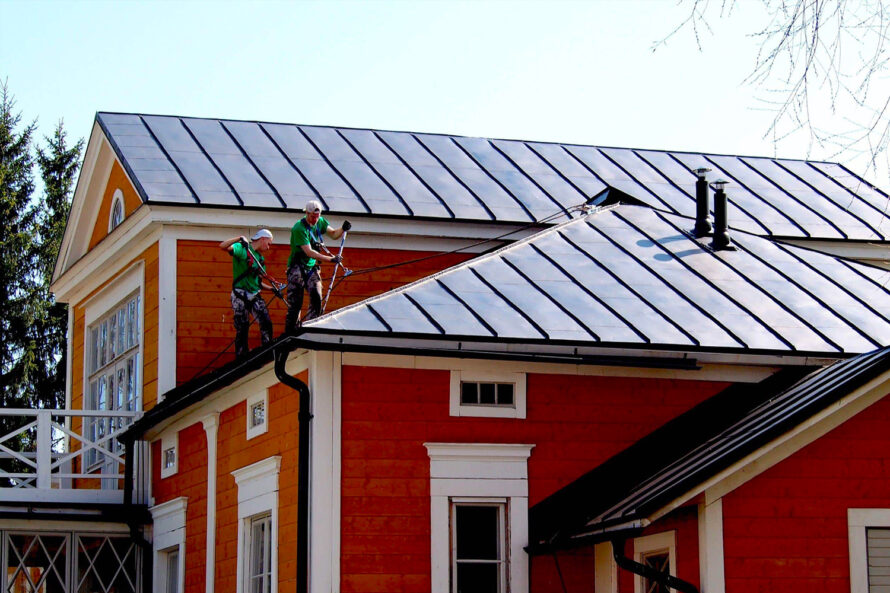
Roof painting is one of the best and most cost-effective ways to extend the life of a roof.
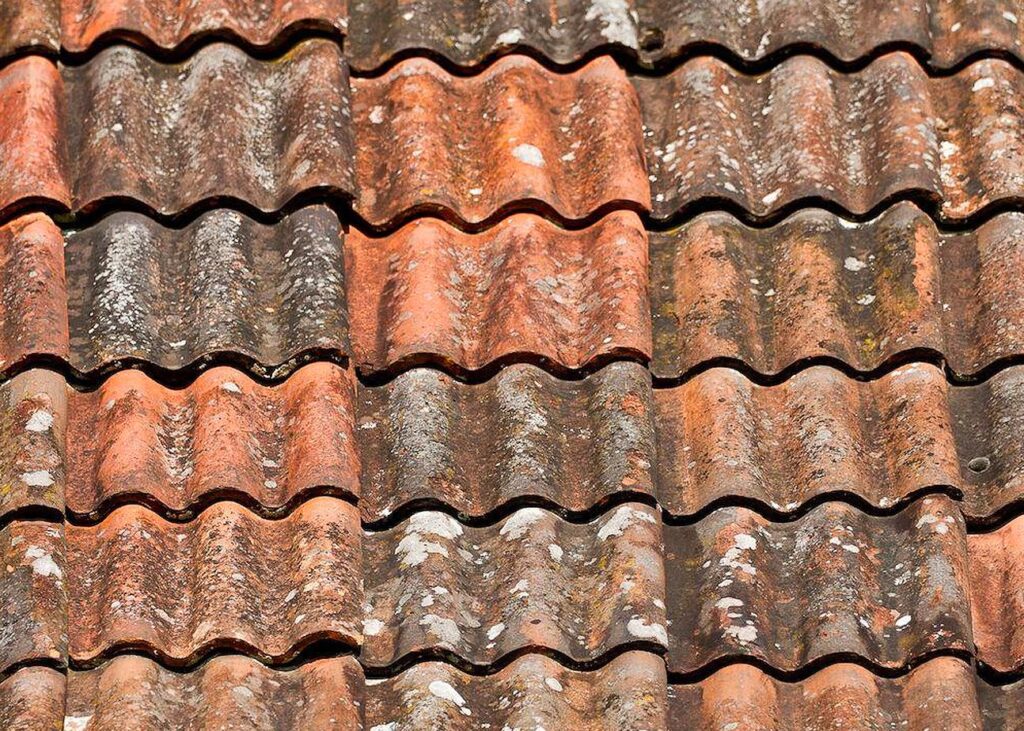
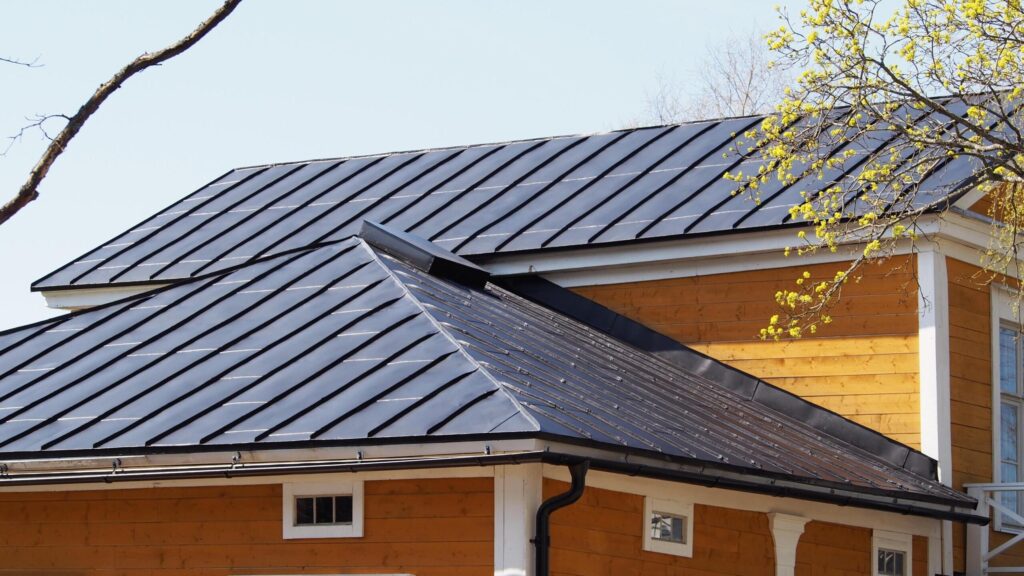
In this article, we’ll go through how to properly paint a standing seam metal roof. When discussing the protection of a tile roof with a colored or clear coating, we usually talk about roof coating rather than painting. You can read more about this in our article How is tile roof coating done?
Paint adhesion to a metal roof requires a clean surface
Preparation work is important in all painting projects. In exterior painting, however, its significance is even greater and significantly affects the durability of the roof paint. The first task in metal roof painting is to thoroughly clean the roof.
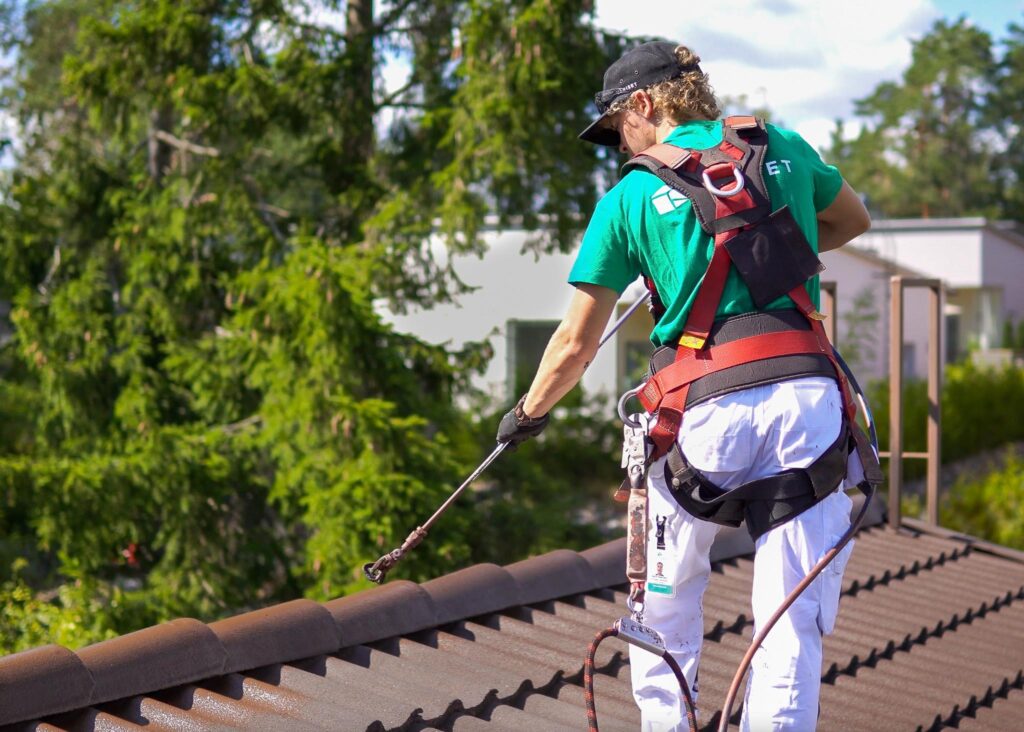
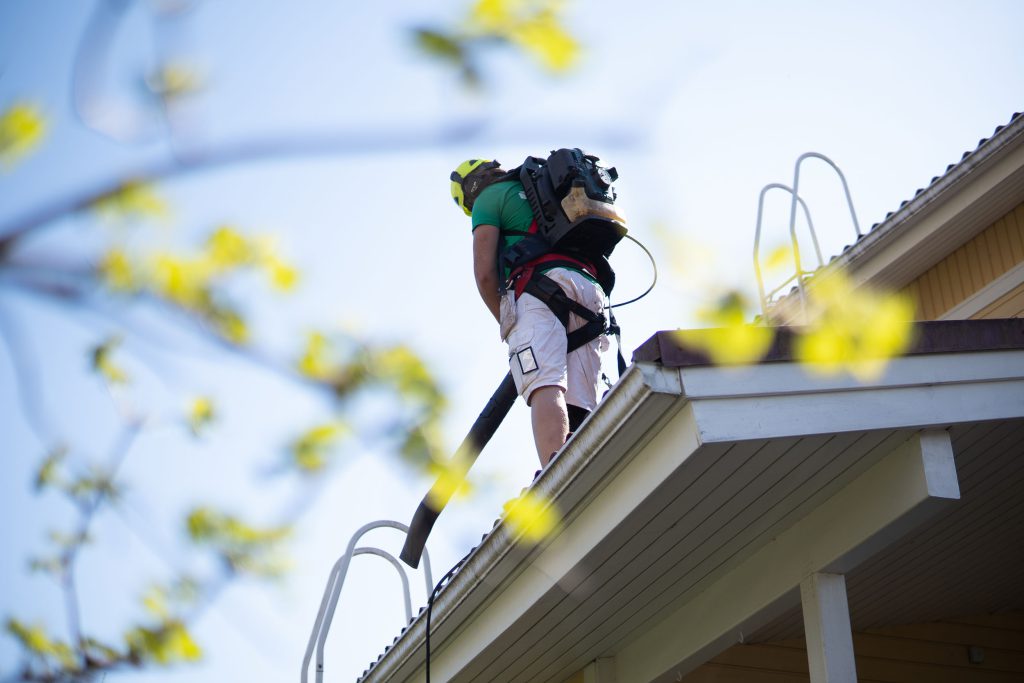
A gasoline-powered pressure washer designed for professional use, with sufficient pressure and water volume, works best for washing a metal roof.
It’s worth emptying the gutters and downspouts so that the wash water can flow freely through them.
Before starting the wash, check the roof for flashings and penetrations for any leaks or holes. It’s also worth emptying the gutters and downspouts so that the wash water can flow freely through them.
In addition to the pressure washer, washing a metal roof requires a brush and a cleaning agent designed for metal roofs, such as Teknos Peltipesu or Tikkurila Panssaripesu. Apply the cleaning agent to the roof, let it work for the time specified in the instructions, and then wash it off thoroughly with plenty of water while scrubbing with a brush.
The cleaning agent should preferably not dry during washing, as it becomes much harder to wash off when dried. No cleaning agent should remain on the metal roof, as it can cause the paint to detach from the roof prematurely.
Rust removal before maintenance painting
After washing, check the roof for rust spots. If found, they must be removed before applying paint. Rust removal must be done very carefully to ensure all rust is completely removed before applying the primer.
If even a small amount of rust remains under the paint, the primer cannot adhere to the metal due to the thin layer of rust in between.
If even minor damage occurs to the paint surface, the paint will detach from the spot-painted area again very quickly.
The paint may stay on the roof for a year, for example, or as long as the paint film is not damaged. But if even minor damage occurs to the paint surface, the paint will detach from the spot-painted area again very quickly.
During rust removal, all poorly adhering old paint is also removed from the roof. Poorly adhering paint may come off already with effective pressure washing.
Exposed paint edges are often sanded smoother to verify that the old paint is sufficiently firmly attached to its substrate.
This also produces a neater final result. After rust removal and other sanding treatment, the metal roof is washed again, once more using a brush and cleaning agent if necessary.
Work stages for metal roof priming and topcoat painting
Once the roof has dried thoroughly after washing, it’s time for priming. The entire roof doesn’t need to be primed when it’s maintenance painting—it’s sufficient to prime the bare metal spots.
Priming is done with a separate rust-preventive primer. All exposed areas are carefully painted slightly beyond the bare area onto the old paint to ensure the metal spots are properly protected.
Priming is done with a separate rust-preventive primer.
The second function of the primer is to provide a better bonding surface for the topcoat. The primer should be painted as soon as possible after rust removal, as unprotected roof metal is very susceptible to rusting again. Allow the primer to dry thoroughly before the topcoat painting stage.
A metal roof can be painted with either a brush or spray gun, depending on the chosen paint. Topcoat painting begins with the primed areas, where a very light coat of paint is applied. The purpose of this is to even out color differences and ensure single-coat coverage.
A metal roof can be painted with either a brush or spray gun, depending on the chosen paint.
If this step is skipped, the different-colored primer may show through the topcoat, making the roof look blotchy. After the primer, the metal roof is painted throughout, paying special attention to the seams.
Why Should a Metal Roof Be Painted?
Due to varying weather conditions, roofs are subjected to very heavy stress here in Finland. In warm seasons, the roof metal expands; in winter, it contracts.
Summer’s scorching sun, autumn rains, and winter snow loads are all factors that test a metal roof.
The most common material for standing seam metal roofs is galvanized steel sheet, which is later protected with a paint coating. When bare steel reacts with its environment, it oxidizes and begins to rust. On top of the thin steel sheet is a thin zinc layer whose function is to protect the steel sheet from corrosion.
However, the zinc layer is not permanent. It is particularly worn by air pollutants such as carbon, sulfur, and nitrogen compounds, which are more abundant in urban and industrial environments. The best protection against these atmospheric stresses is an intact paint surface that protects both the zinc layer and the metal beneath it.
If completely neglected, a metal roof can reach the end of its life in as little as 20 years. Regular maintenance thus extends the roof’s service life by even decades and consequently saves the homeowner real money.