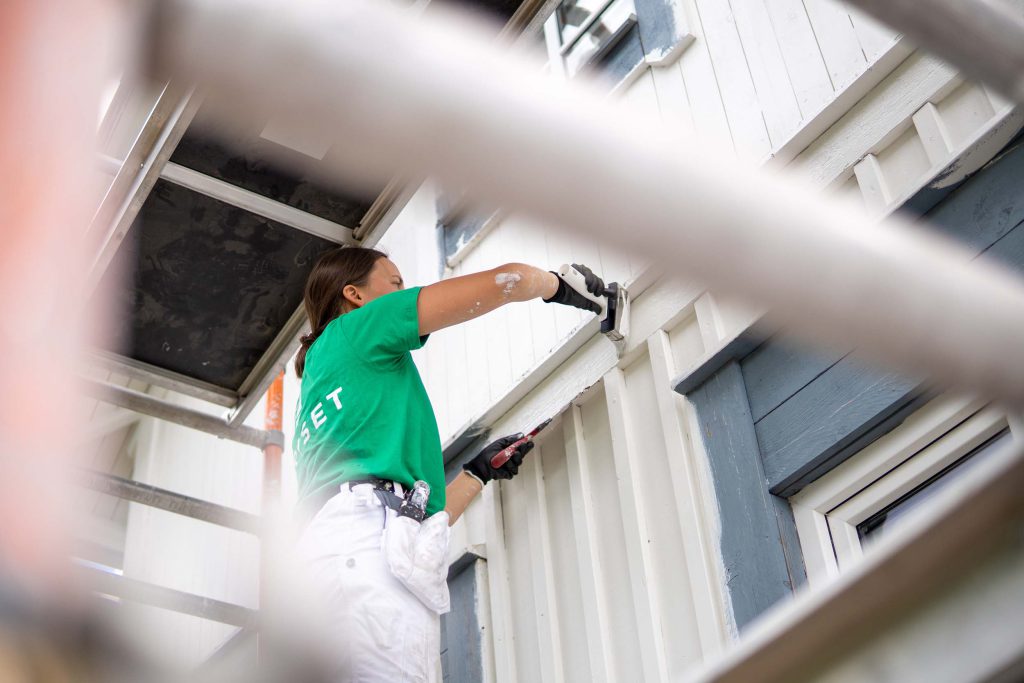
Washing your house is an important part of exterior wall painting. The significance of this step cannot be overstated, but contrary to what you sometimes hear, it doesn’t automatically mean pressure washing the walls.
In this article, we’ll go through how to wash your house’s wooden exterior walls step by step. We’ll also cover cleaning the wooden parts of a brick-clad house.
Why Is Washing Exterior Walls So Important?
Over the years, rough paint surfaces accumulate road dust, soot, pollen, and other dirt. The more porous the paint surface becomes over time, the more easily dirt adheres to the wall.
The more porous the paint surface becomes over time, the more easily dirt adheres to the wall.
A dusty and dirty surface provides good growing conditions for mold and algae. Surfaces painted with water-based paint rarely develop mold, but mold is very common on walls painted with oil-based paints.
If painting is done on a dirty surface, the result will likely be premature paint failure. This can show up immediately during painting as poor adhesion, but more likely the problem will appear somewhat later.
If painting is done on a dirty surface, the result will likely be premature paint failure.
To avoid unnecessary extra work and save time and money, walls must be thoroughly cleaned before picking up the brush.
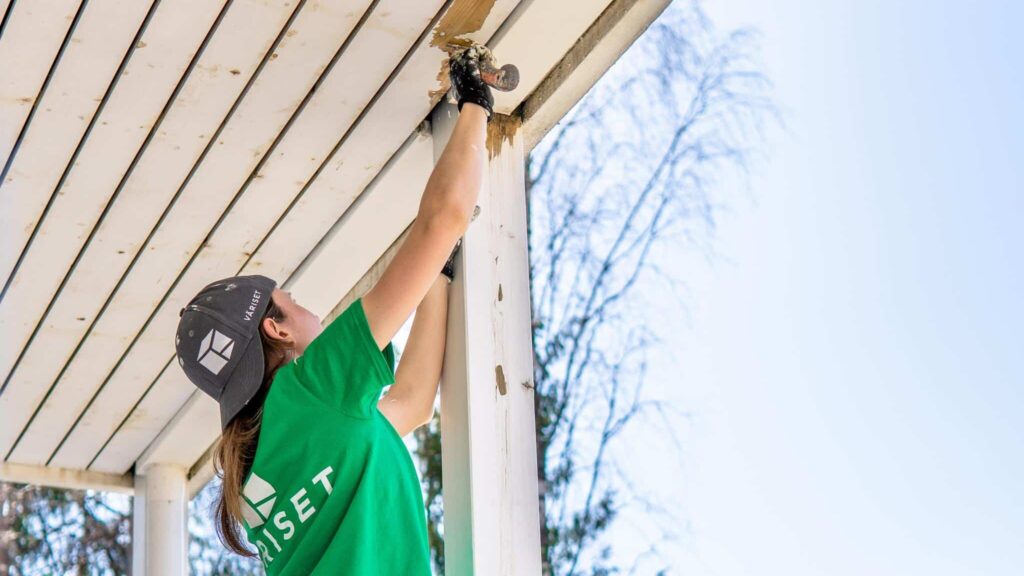
While brushing the walls, you can easily see whether the old paint is still firmly attached to the wall or if there’s any loose paint that needs to be scraped off.
Instructions for Washing Moldy Wooden Walls
Mold spots should never be left under new paint, because it will continue living under the paint and eventually cause the paint to detach from the wall. If there are even small mold spots on the surface, maintenance painting always begins with washing off the mold using a mold cleaner.
The moldy area is moistened with a hose and diluted mold cleaner is sprayed on the surface. The cleaner is allowed to work for about 15 minutes or the time indicated in the instructions. Throughout this time, the surface must be kept moist with the cleaner.
Mold should never be left under new paint, because it will continue living under the paint and eventually cause the paint to detach from the wall.
If it’s a hot day or the cleaner is otherwise drying on the wall, spray more solution periodically to keep the moldy areas moist while the cleaner works.
Mold cleaner softens the mold, after which it comes off easily by brushing and rinsing with plenty of water.
If the mold doesn’t seem to come off, repeat the process and if necessary use a slightly stronger solution and let it work a bit longer. When the product has worked long enough, the mold comes off relatively easily.
When using mold cleaner, always check the solution strength. Mold cleaner is essentially chlorine—it kills organic matter and softens the paint surface. This means that if undiluted mold cleaner splashes on, for example, a deck or window sills, it will leave unsightly stains on the surfaces.
Be careful with mold cleaner and protect sensitive areas as needed.
Similarly, it damages plants and clothing if it gets on them, so be careful with mold cleaner and protect sensitive areas as needed. Mold cleaner must always be thoroughly rinsed off everywhere, including around the cleaned area.
Mold cleaner dulls and wears the paint surface and therefore always requires maintenance painting afterward.
Another thing to note is that mold cleaner dulls and wears the paint surface and therefore always requires maintenance painting afterward.
Mold cleaner is therefore not suitable at all for maintenance washing done between paintings—for that, choose a milder cleaner.
Washing Your House When There’s No Mold on the Walls
If there’s no mold on the wall, it’s enough to brush dirt and dust off the walls with a dry, soft brush. Washing with water is not essential for successful painting if there’s no visible dirt.
Washing with water is not essential for successful painting if there’s no visible dirt.
If there is dirt and it doesn’t come off with dry brushing, you can use water and paint cleaner. A suitable cleaner is, for example, Tikkurila’s Maintenance Wash, but there are other options available.
The cleaner can be applied with a sponge, brush, or sprayer. When the wall will be painted after washing, it doesn’t matter whether you start washing from the bottom or the top.
However, if it’s a maintenance wash done between paintings and the walls won’t be painted afterward, washing should always start from the bottom and work upward. This is because when dirty wash water runs down onto a dry and porous surface, it leaves unsightly dirt streaks on the wall that can be particularly noticeable on light-colored surfaces.
Just as with mold cleaner, other cleaners shouldn’t be allowed to dry on the wall either—the wall must be kept moist with the cleaner while it works, usually for about fifteen minutes.
We don’t recommend using a pressure washer to wash wooden walls.
When the cleaner has worked and softened the dirt, wash the wall with a brush and then rinse thoroughly with water. After washing, the wall should be allowed to dry undisturbed.
We don’t recommend using a pressure washer to wash wooden walls. However, if you decide to use pressure washing, it’s important to set the pressure low enough.
If water is sprayed at high pressure onto deteriorated wood siding, it can damage the wood surface and at the same time water penetrates too deep into the wood, making it take much longer to dry.
When moving to the painting stage, the surface must be clean and dry so that the new paint can adhere properly to its substrate.
A Couple of Special Cases in Washing Wooden Exterior Walls
Brick-clad house. Brick-clad houses often have wooden parts that need maintenance painting, most typically around windows, in gable ends, and on eaves. When washing the wooden parts of a brick house, you need to be a bit more careful than when painting an entirely wood-clad house.
The brick wall next to the wooden parts is considerably more porous as a material than painted wood surfaces and absorbs wash water effectively unless protected. When washing wooden parts, all brick sections below the washing area must be well protected. Apart from protection, the wooden parts of a brick-clad house are cleaned the same way as an entirely wood-clad house.
Red ochre painted wooden house. Surfaces painted with red ochre paint are not washable in the same way as surfaces painted with film-forming paints. Red ochre painted surfaces must be handled carefully. If necessary, a dirty surface can be lightly brushed or washed with water only. However, red ochre paint comes off its substrate when brushed, so red ochre painted walls shouldn’t be washed unnecessarily.
Read more about painting your house’s exterior walls at Väriset.
Request a free assessment visit
During the assessment visit, you’ll receive an expert evaluation of your house’s facade and roof maintenance needs as well as a fixed-price quote.