Installing snow guards is the best way to prevent property damage and personal injury caused by snow falling from the roof.
Sometimes you hear people say that it’s good to let the snow come down from the roof if there are no snow guards. This is true in itself, but it also carries its own risks: an uncontrolled load of snow falling down can cause damage to the building’s structures or, in the worst case, it can fall on someone’s head with serious consequences. Installing snow guards is therefore the best way to prevent property damage and personal injury caused by snow falling from the roof.
The situation is good in this regard for new buildings, as nowadays installing snow guards is required before the final inspection. In older buildings, however, there may not be any snow guards at all.
Snow and ice falling from the roof are the property owner’s responsibility
In Finland, the roof structures of residential buildings generally withstand snow loads very well. Despite this, accumulated snow loads should be removed from the roof in a controlled manner rather than letting them come down on their own. A particular reason for this is that any damage caused by snow falling from the roof is the property owner’s responsibility. If snow falls from the roof onto a car or a person, for example, the property insurance will not cover this. There are several precedents for this.
Snow guards can significantly increase the safety of the house or property’s yard area. However, it should be noted that even snow guards do not completely prevent snow from falling from the roof, and it is recommended to remove snow and ice accumulating on the roof edges in any case.
Drip edges or roof walkways do not replace snow guards
Traditional standing seam metal roofs often have drip edges. Drip edges folded from sheet metal do not replace snow guards, even though in some cases they might keep snow on the roof. However, their snow load capacity is nowhere near the same class as approved snow guards. When the snow load grows large enough, drip edges may fail. In the worst case, this can cause damage to the roof and the building’s structures. Official snow guards should always be installed above the drip edge.
Often, when installing snow guards, other necessary roof safety products are also installed on the roof, such as roof walkways and roof ladders. According to regulations, the roof must have fixed roof walkways so that all areas requiring maintenance can be accessed safely. Just like snow guards, installing a roof walkway is now also required at the final inspection if there is a chimney or other element requiring maintenance on the roof. It is important to note that a roof walkway does not in any way replace a snow guard.
How to choose snow guards and how are they installed?
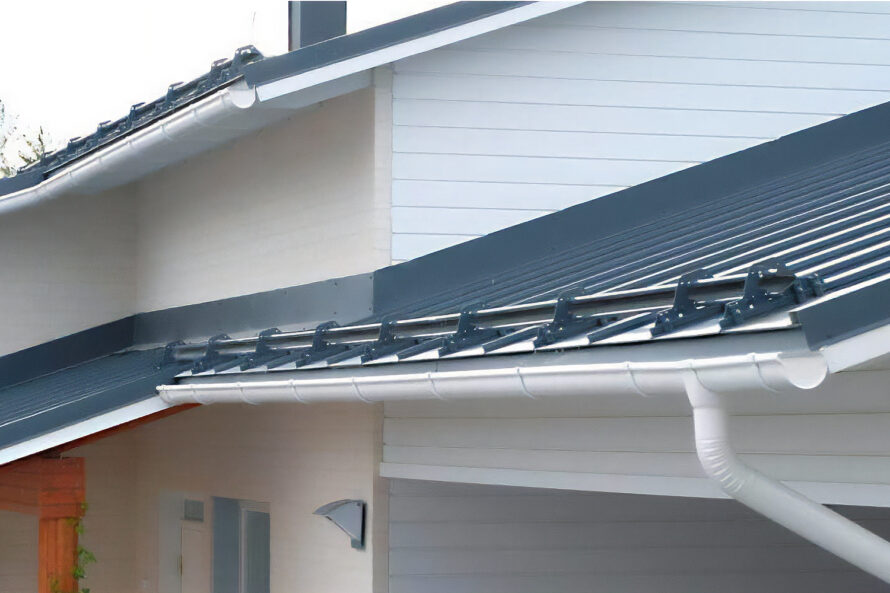
There are many types of snow guards and they are available in practically all different colors. The most typical snow guard model is the traditional two-pipe model, which can be installed on practically all different roof types. Another very common model nowadays is the profile snow guard, which is folded from sheet metal. Snow guards are available from several different manufacturers. Perhaps the two most common of these are Pisko and Nesco.
When choosing snow guards, factors such as roofing material must be taken into account, as different types of roofs have different fasteners. When purchasing snow guards, it is good to make sure that the selected product is suitable for your particular roof.
The delivery of snow guards usually comes with clear instructions for their installation. When installing snow guards, it is extremely important that they are installed according to the manufacturer’s instructions. This ensures that the snow guards can withstand the required load.
In addition to following the instructions, it is important to have the appropriate tools. This ensures that the installation work is smooth and safe. When installing snow guards or other roof safety products, work safety must always be taken care of. When working on the roof, using a harness is absolutely essential. In some cases, it is wisest to install snow guards either from scaffolding or from a lift.
Väriset Oy no longer installs rainwater systems or roof safety products. We’re still happy to serve you with exterior cladding painting as well as tile roof coating and cleaning.