How should you deal with old paint layers when planning to maintenance paint your house’s exterior cladding? This is something many people planning house painting wonder about. To help with this consideration, we’ve listed advice on when, why, and how old paint should be removed from exterior walls.
How do you know if removing old paint from exterior walls is necessary?
A successful painting project requires careful preparation work. Preparation includes cleaning the surfaces to be painted and, when necessary, removing old paint and applying primer. However, it’s not always sensible or necessary to remove the old paint layer.
If the paint is firmly adhered to the wall, it can safely be left in place. In this case, it serves as a good primer for the new paint surface. This is often the situation when walls have been kept clean and maintenance painted regularly at intervals of about 10–15 years.
Only paint that is poorly adhered and flaking or peeling should be removed.
If the painting interval has stretched too long or if there are problems with the paint surface, the paint may start to flake and peel away from the wall. In such a situation, it’s absolutely essential to remove all poorly adhered old paint before repainting. Even then, not all paint needs to be removed. Only paint that is poorly adhered and flaking or peeling should be removed.
Sometimes the situation is unclear if there’s no obvious problem with the paint surface, but it’s been a long time since the last painting. In this case, you can perform what’s called a fingernail test.
In the fingernail test, paint is removed from a small area to expose the paint edge. Then a fingernail or, for example, the corner of a library card is gently pushed under the paint edge and the paint surface is lifted. If only a fingernail or corner-sized chip of paint comes off the paint surface, the paint is sufficiently firmly adhered to the wood and removing it is not necessary. However, if the paint comes off in a strip from a larger area, it should be removed from the weak sections.
Why does old paint need to be removed?
New paint always adheres on top of old paint. If the old paint is poorly adhered to its substrate, the new paint won’t have any surface to grip onto either. Removing old paint from exterior walls creates a good and durable substrate for the new paint to adhere to.
– paint that has started to come loose will eventually come off completely, taking the new paint surface with it.
Sometimes you might mistakenly think that new paint would act like glue for the old, poorly adhered paint surface and reattach it to its substrate. However, this is not the case – paint that has started to come loose will eventually come off completely, taking the new paint surface with it.
If the exterior cladding is old, multiple paint layers may have accumulated on it. This doesn’t matter when the paint surfaces are intact and well adhered to their substrate. However, if there are many layers and they show extensive flaking or peeling of varying degrees, you should consider replacing the exterior cladding.
Another option would be to remove all paint from the wall, which is an enormous amount of work.
How is poorly adhered paint removed?
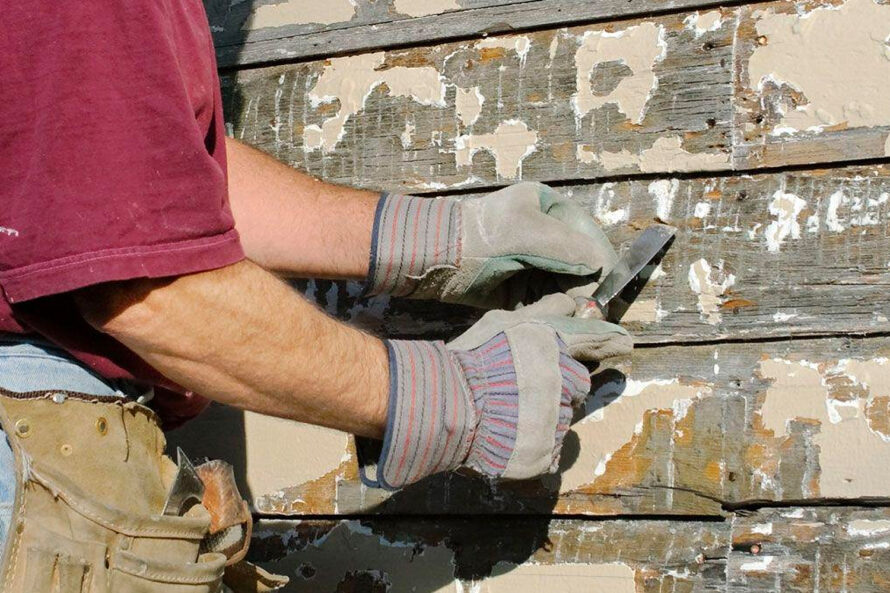
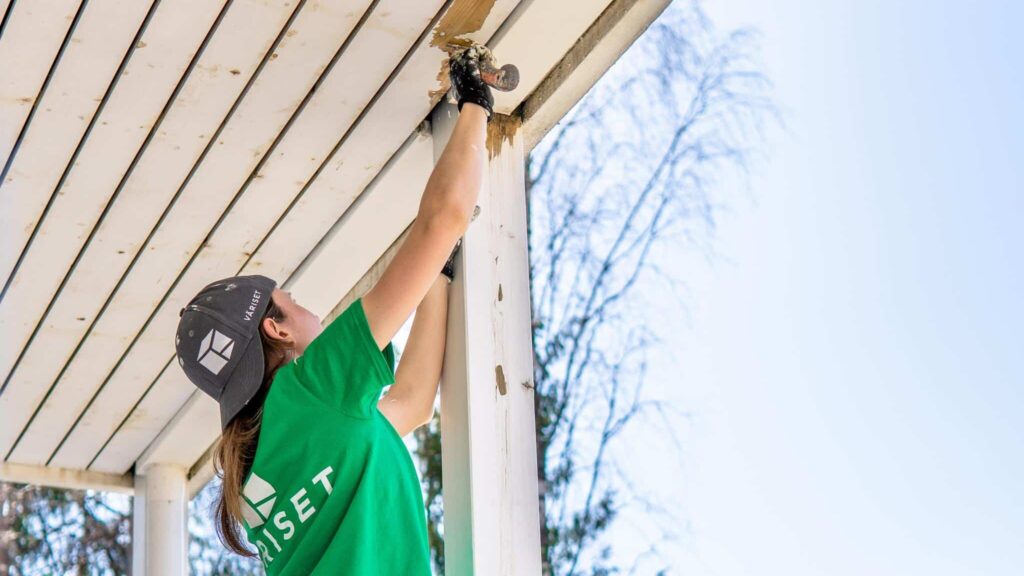
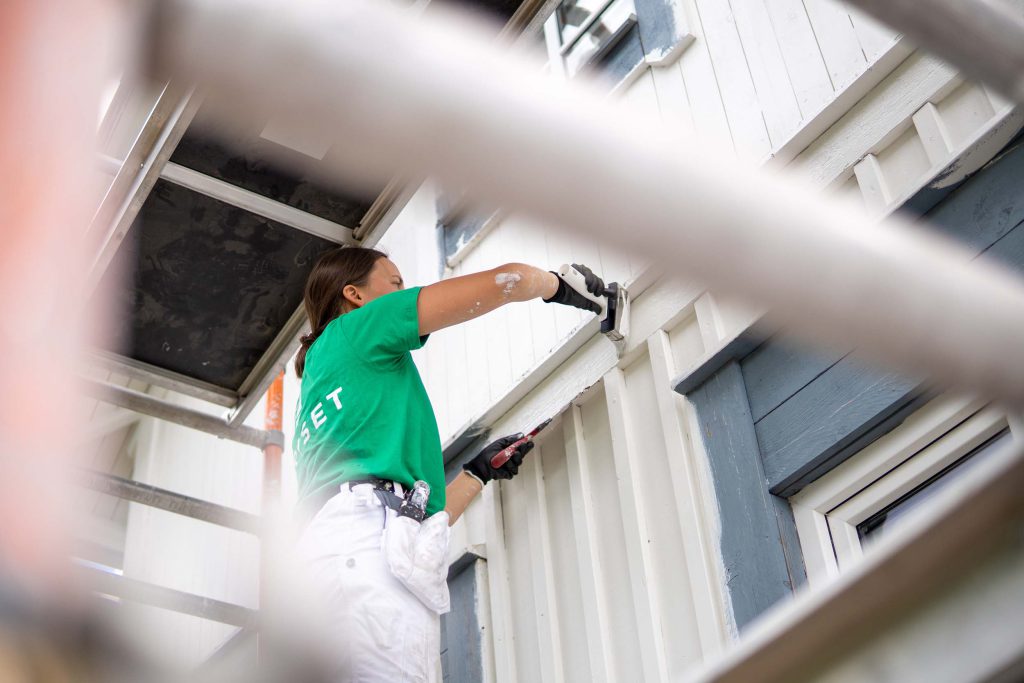
The best tool for paint removal is a paint scraper or scraba. As the name suggests, it’s used to scrape the paint layer off the wood surface.
The most effective method is to pull strokes as long as possible with an even rhythm, following the wood grain. The paint scraper blade is hardened steel, so care should be taken when using it. Strokes should be made parallel to the board across the full width of the blade, never crosswise or at a sharp angle.
Board tongues and grooves and corners are easily damaged, and no paint will cover the deep grooves that a paint scraper corner can cause in exterior cladding boards. Window glass must also be protected, as the paint scraper blade scratches it very easily.
After scraping, wood surfaces may sometimes need finer treatment, which is done with sandpaper. Exterior cladding usually doesn’t need to be sanded, but for example when painting window sills, sanding should always be done. It’s also always worth removing raised splinters that occur if board corners are accidentally scraped.
It’s worth having several different scrapers of different sizes, as the house’s exterior cladding has many kinds of corners and surfaces of different sizes.
The scraping level is sufficient when paint no longer comes off the wood surface in pieces during strokes.
Scraping is hard work in places, but it’s worth doing carefully. Not all paint needs to be removed – firmly adhered paint can be left on the wall. However, all poorly adhered paint should be scraped off. The scraping level is sufficient when paint no longer comes off the wood surface in pieces during strokes.
Here too, you can use the previously mentioned fingernail test as an aid.
Cleaning and priming after paint removal
When old paint has been carefully removed from the exterior wall, the walls must be thoroughly cleaned before painting over them. This is because scraping creates paint and dust mess that prevents paint from adhering properly to its substrate.
Paint applied to a poorly cleaned surface may start to flake and peel prematurely. Depending on the situation, dry brushing is sufficient for cleaning, but if there are, for example, mold spots on the wall, a proper water wash should be done using suitable mold or paint cleaning agents.
Bare wood sections exposed during old paint removal must always be primed before finish painting. The purpose of primer is to improve the adhesion and grip of the finish paint, even out the substrate’s paint absorption, and enable an even-colored final result.
There are separate primers for this purpose, but finish paint diluted by about 10 percent often works as well. However, when choosing a primer, compatibility with the surface being treated and the chosen finish paint must always be verified.
After this, the exterior cladding is ready to receive a fresh paint surface and rise back to its former glory.
Read our customers’ experiences with house maintenance painting. Remember that if you wish, Väriset can handle this painting job for you too. Request a free assessment visit here.
Request a free assessment visit
During the assessment visit, you’ll receive an expert evaluation of your house’s facade and roof maintenance needs as well as a fixed-price quote.