Painting a house with traditional methods – ecological exterior painting with heritage oil paint
Laura Keski-Kuha
19.05.2026
Painting the exterior of an old wooden house is not just a surface renovation. When done correctly, painting protects the structures, extends the lifespan of the wood cladding, and preserves the building’s original appearance for decades to come. More and more homeowners are now interested in traditional painting methods and more natural materials. This is why painting a house with traditional methods has once again become a valued option, especially for old wooden houses, log buildings, and culturally significant properties.
What are heritage oil paints?
Today, water-based exterior paints and alkyd oil paints are mostly used for exterior house painting. Water-based paint is easy to use, dries quickly, and is suitable for most buildings. Alkyd oil paint, on the other hand, is a solvent-based oil paint with synthetic alkyd resins as the binder. It is a durable option especially for demanding projects, but does not breathe in the same way as more traditional oil paints.
Heritage oil paints such as linseed oil paint are older alternatives based on renewable natural raw materials compared to the above. Their greatest advantage is breathability: the paint allows moisture to move through the wood naturally, the surface patinas beautifully without flaking in large chips, and maintenance painting can be done with lighter preparation work than with paints that form film-like surfaces.
What types of projects are heritage oil paints suitable for?
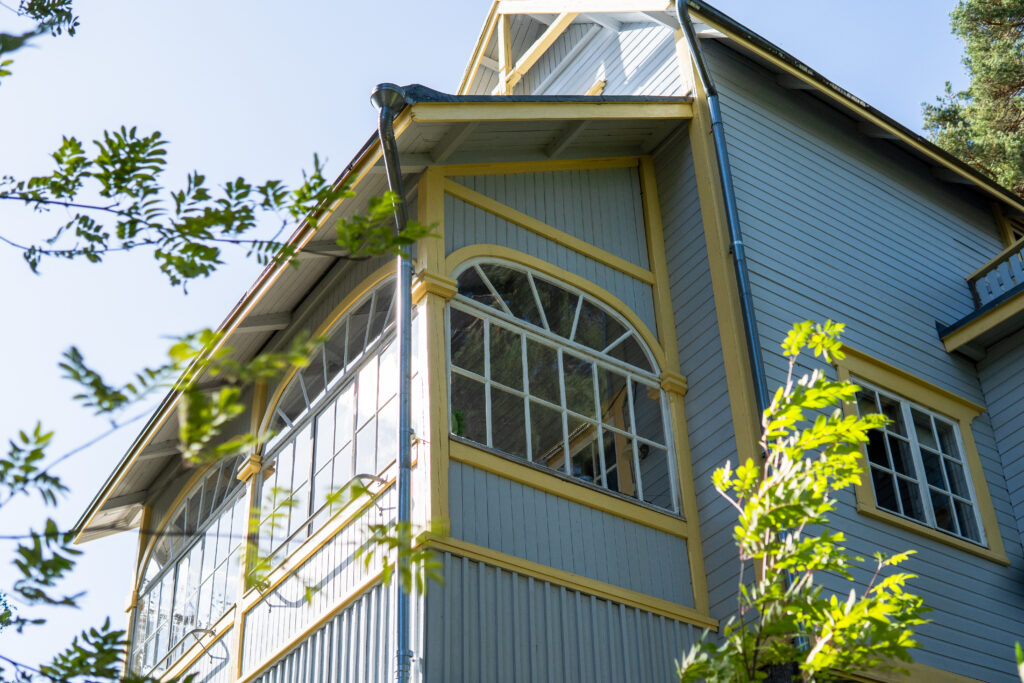
Heritage oil paints are especially recommended for old wooden buildings. Typical projects include log buildings, houses clad with rough-sawn boards, and culturally significant buildings where the original appearance and construction method need to be preserved.
Linseed oil paint is particularly suitable for projects that have already been painted with oil paint. Red ochre paint, on the other hand, is the most natural choice for log and sawn board surfaces, where it has traditionally been used.
Heritage oil paint is not a suitable choice for houses or surfaces that have previously been painted with water-based paint. For these projects, modern exterior paints are a more practical solution.
What are the advantages of heritage oil paints?
Heritage oil paint penetrates deep into the wood and adheres exceptionally well to the surface. When fresh, it forms a tight surface, but over time it becomes breathable. This characteristic is precisely why old wooden houses have been painted with oil-based paints for generations.
Exterior painting done with traditional oil paint remains in good condition for a long time, and its maintenance does not usually require extensive preparation work. For many homeowners, it feels like an attractive choice also because it is largely based on renewable raw materials and patinas beautifully instead of flaking in large chips.
Red ochre paint – a very traditional exterior paint
Red ochre paint is a boiled paint made by boiling water, iron sulfate, rye flour, and linseed oil. It is completely breathable: the wood gets wet and dries through the paint normally. Red ochre paint is especially suitable for log buildings and board surfaces. However, red ochre paint cannot be painted over other paint types.
Red ochre paint can be recognized by the fact that when you wipe the wall, red pigment remains on your hand. It does not form a film but is absorbed into the wood. This makes it very easy to maintain: loose paint is brushed off and a new coat is painted on top.
You can also make red ochre paint yourself. You can find instructions on the Finnish Heritage Agency’s Korjaustaito website here.
Ecological exterior painting is above all long-lasting
Ecology does not only mean what is written on the side of the can. The long lifespan and easy maintenance of a building are important factors.
When wood cladding remains in good condition for decades, the entire building’s lifecycle is extended, and that is an eco-friendly act in itself. With heritage oil paint, there are good conditions for this, as long as the painting is done correctly.
Heritage oil paint or modern water-based paint?
Modern water-based exterior paints differ from heritage oil paints in both usability and final result. The following table compares the most important characteristics.
Characteristic
Heritage oil paint
Water-based exterior paint
Best suited for
Old wooden houses, culturally significant properties
New buildings, most buildings
Preparation work
Often lighter
Varies depending on the project
Paintability
Requires precision: thin coats, brushing so that no streaks remain
Easier to apply evenly
Maintenance painting
Often easy
Varies depending on the project
Drying time
Slow: several days or even weeks
Fast: a few hours
Use in Finland
Not so common nowadays
Most common choice
Price
Usually more expensive
More affordable
Can you paint a house with heritage oil paint yourself?
Exterior house painting can be done as a DIY project in many cases, but experience is invaluable when working with traditional paints. Especially for old or culturally significant properties, it is worth finding someone who knows the materials and working methods in practice, not just in theory.
A well-done paint job shows on the building for a long time. The right paint type, careful preparation work, and a technique suitable for the project together create a surface that can be enjoyed for decades.
Väriset is here to help with both traditional and modern painting projects. Get in touch, and we’ll plan a painting job worthy of your home together.
Fall in love with your home again – See our services
House Painting
Fall in love with your home again - restore your home's appearance and value
Exterior house painting restores your home's appearance and value. Flawless workmanship is of utmost importance to us. We always ensure that the final result is even and perfectly finished.
Timely roof maintenance extends your roof's lifespan by decades
An intact, maintained, and painted roof is every home's most important protection. Tile roof coating and maintenance services as well as metal roof painting services as turnkey solutions.
Take advantage of the household deduction – up to €4,200 benefit from the work. Try the calculator
The household deduction in 2026 is 40% of the VAT-inclusive portion of the work performed. The deductible is €150. The benefit is €2,100 per person, meaning the maximum deduction for a couple is €4,200 in total
Order a free survey visit to your home. You'll receive an assessment of maintenance needs and a quote for the work. Book a survey or calculate a price estimate with our calculator in just a few minutes.
Ostrobothnia, South Ostrobothnia, Central Finland, Central Ostrobothnia, North Ostrobothnia, Lapland, Kymenlaakso, Päijät-Häme, South Karelia, South Savo, Kainuu